Your Only Alternative, is to Find an Alternate…

…or you cannot compete in the contest.

Seems easy enough, right? We have a verb, and an adjective. But enough of that boring English lesson stuff. When I have seen these two words interchanged, it is because the writer used the verb as an adjective, and the adjective as the verb.

Some ideas to help all of us out. You can be an alternate in the spelling bee. You can alternate turns of who washes the dishes.

If you do not want to wash the dishes at all, you need to find an alternate, or better yet, come up with an alternative plan. Such as eating out. Then no one is washing the dishes. Well; no one except the employees at the restaurant.

Alternative is a substitution; a different choice besides the one proposed.

Alternate means take turns, and alternative means a different choice.

Where Are You Going To Wear That Outfit?

There is a third “ware”, but is generally not used any longer, so I just decided to leave it out of this post. But back in the day, before retail stores were on every corner, people used to go door-to-door to sell their wares.

Now, I have also seen people use we’re when they should have used where, but since that is so far beyond even being related to where, I will discuss that in another post as well.

So what exactly are these two words? One is a verb, and one is an adverb. You can wear something, which is an action, or verb. You can wear a frown, you can wear a jacket, and you can wear your hat.

But you cannot where you hat. Unless if you lost your hat. Then you need to know where your hat is. Where is an adverb. Where is a destination, a place, or somewhere you want to be.

B&O 9-18-2015

This is a Perfect Example of What is Wrong With Our Education System

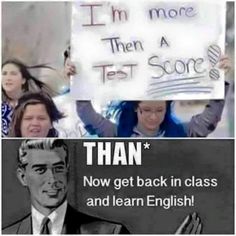
I am sure you have already had a good laugh from this image. Unfortunately, it is one of many examples of people trying to make points about how they are in control of their education, and know what is going on, yet they cannot spell simple words.

Unfortunately, this embarrassment will follow this hopefully-not-teaching-your-children person for the rest of her life.

Test Score Image

I am pretty sure I know what your test score is going to be…

So, my whole point here, was than versus then.

As I like to not get into the rules-and-regulations of my AP English classes eons ago when I was in high school, or the APA and Purdue formatting rules. I am going to keep this simple.

Then = next, after, also, as well

Than = instead of, in place of, not to be confused with.

Confused? Me too. Some examples…

I would rather sleep in than get up early to go fishing.

I am going to go fishing, and then come home and have breakfast.

I will fix the sink for you, then I am going out.

I would rather eat dirt than have this conversation with you.

Do these two words get you caught up? What words get you caught up that drive you mad?

Let me know, and I will post some solutions!

Happy writing, and happy reading!

Anymore, or Any More? Which One To Use, and When To Use It!

The lovely English language has several words that can be written two ways, and mean two different things, when used properly, in two different ways. (Yes; more comma-abuse by yours-truly!)

Store Image Pictures 008

Anymore, or any more? Awhile, or a while?

Anymore is considered a misspelling by many readers, writers, and editors. Most feel that any more is only interchangeable with any longer, and that anymore is an adjective that should never be used. Because they feel it is not a real word.  As a note, when I am reading something and see this, it doesn’t make me cringe.  When I am editing and see it, I change it to any more.

Awhile should only be used when it can be substituted with ‘for a while’, and still make sense.

“We waited awhile before getting our table.” or “We waited for a while before getting our table.”

This is considered an adverb.

The word ‘while’ can be used as a noun, and in this case you need to say ‘a while’, and not ‘awhile’.

“I just talked to him a while ago.” Saying “I just talked to him for a while ago,” does not make sense. This lets you know it is a noun in this sentence, and not an adverb.

I think most difficult English language situations can be figured out by substituting the word/phrase that is in question, and see if it still makes sense.

What ones trip you up?

They’re on their way, and will call you when they get there.

How difficult is that to say? Try writing it. Possessive nouns, adjectives, and verbs will drive you mad.

They’re is means they are…. But how did we get won’t from will not? How did we make that leap?

The English language is the most difficult language to learn. And now try writing a story in it.

While dealing with your crazy-nutcase-editor who tells you I-before-E and pay attention.

I have 4 pages full of these instances and how to learn them fast, so you can write your book and let your editor do the hard work.

More to come tomorrow!

Do I Use an “A”, or Do I Use “An”? And Does It Really Matter?

Yes, it really does matter. Especially to whomever is reading your writing.

Store Image Pictures 002

One of the most common errors I see when reading online comments, stories, blog posts, etc. is the incorrect use of “a” and “an”.

A very simple rule can help you remember which one to use when. If the word following it starts with a consonant, you use “a”. If it starts with a vowel, you use “an”. Simple enough, right? Except for if the word starts with a consonant that is silent, so the word sounds like it starts with a vowel.

Are you still with me? Good. It will all look clear in a minute. 

Such as, “I will be over in an hour.” Or, “I would like an honest answer.”

This also makes sense: “Can I have a pencil?”

Saying “Can I have an pencil?” is painful to read. And yes, I have read this very sentence.

In a book.

That was published.

An editor can be your best friend 🙂 (Did you see what I just did there?)

But then there is also the issue of initials and numbers. In that situation, you will choose “a” or “an”, depending on the way it is sounded out.

“An FDA employee arrived.” The sound of “ef” is why you would use “an”.

“A United States tour.” The sound of “yoo” is why you would choose “a.”

“He gave me a $50.00 bill.” It is the same rule here. You want to choose based on how it sounds, not necessarily how it is spelled.

The more you see these being used incorrectly, the easier it is to tell when you are using it correctly.

What are some issues you have with the very difficult English language and writing rules? Is there something you would like me to address here? Let me know and I will get a post put up covering your questions and concerns!

Until next time…happy writing, and happy reading!

It’s Time To Change Things Up; Again!

Or at least I am going to try to get some things changed on this site. The last time I tried to move over to Bluehost, I lost all of my followers, my posts; pretty much everything.

So I was thrilled to see that WordPress has a business site that means I do not need to move my domain and blog.

Okay, it is a bit pricey per year, but after the stress I went through when I tried this the last time, I am more than willing to hand over the cash to save me any headaches I would again cause myself by attempting to do this on my own.

I used to be computer-savvy: not any more.

So do you use WordPress.com/business? I hope if you do, you have wonderful things to say about it 🙂

I will likely be spending some time this weekend getting things set up exactly how I want, and with a 2 week free trial period, I can’t go wrong. If I don’t like the way it works, I can just go back to what I am doing now until I find something else. I am going to have to change my theme (which I really like!) because it will not support the menus and pages I want to add. So you will be seeing a new, polished Books & Opinions page very soon!

No, I Do Not JUST Read Books!

books and opinions quote 4-25-15

It is so much more than that. I learn things, and I share the things I learn with others.

I get to experience places and things that otherwise would be off limits to me.

I get to encourage and support new authors, when they feel like giving up, and setting their work on fire.

I get to edit books, and help authors present their best work possible.

There is no such thing as too many books, or reading too much.

If you believe there is, you will never understand what you are missing.

B&O Logo