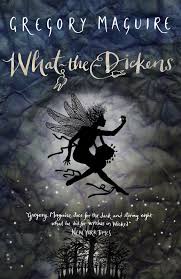
You know, “What-the-Dickens”? That guy. Yep. I’m still reading it. Except I haven’t picked it up in a week. Since about the time my 1st college class started for my MBA. So, I don’t know about you, but I find this completely unacceptable. So I will find a way to manage my time to include my recreational reading and blogging, and tell you how this story ends. Patience is a virtue, right?
and that right there is the truth!
More to come, sooner rather than later (fingers crossed)!
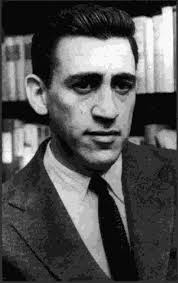
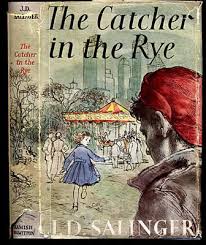
Wrote: The Catcher in the Rye, published in 1951, as well as 3 other novels, including short stories that appeared in The New Yorker. He was drafted into the Army and served from 1942-1944. He was hospitalized after suffering a nervous breakdown after the war. Mr. Salinger lived a very private life, last published a book in 1965, and gave his last interview in 1980.
Odd Fact: Mark David Chapman, the man who assassinated John Lennon, was found with a copy of the book at the time of his arrest and later explained that the reason for the shooting could be found in the book’s pages.
Quote: “What really knocks me out is a book that, when you’re all done reading it, you wish the author that wrote it was a terrific friend of yours and you could call him up on the phone whenever you felt like it. That doesn’t happen much, though.” ― J.D. Salinger, The Catcher in the Rye
The Catcher in the Rye
I have to be completely honest and say I have never read this book! I am ashamed to even say that, but I guarantee after reading the synopsis of this book, I will own it before the weekend is over.
So our little friend What-the-Dickens is finding himself in a messy situation. He is hell bent on finding McCavity, a huge white cat that tried to eat him. It’s the first living thing he saw, and he is bound and determined to find this McCavity, give her a gift, and ask to be her pet.
Sounds reasonable to me.
So on his journey, he manages to be adopted by an out-of-tune rust-throated grisset (a bird of some sort). She snatches him from the ground, but when her babies won’t eat him (they prefer worms of course) she plops him in her nest with the others and flies off to find food for all of them. As timing would have it, What-the-Dickens peeks over the edge of the nest and sees McCavity walking past the tree. She sees her lost dinner, and up the tree she goes. The birds fly the nest, and What-the-Dickens falls out, discovering his webbing helps slow him down from a fall. Once again, he has lost sight of McCavity, and he’s off again, searching for this cat so he can be her pet.
At what is the start of his career as the Tooth Fairy, What-the-Dickens passes the zoo, and an enormous lion with a toothache, knowing it must be a relative of his beautiful McCavity. Not knowing the lion is drugged up on morphine for his surgery the next day to remove the tooth, What-the-Dickens tries to find out if he knows where McCavity might be, ends up in his mouth, and discovers the infected tooth. Surely this huge cat will help him on his way if he removes this tooth, right?
So remove it he does, lucky to not be eaten, and getting no further help, heads off with the tooth as a present for his future owner, and the start of a career under his belt.
What’s up next for What-the-Dickens? Hard to say, but surely there is more trouble heading in his direction!
Are You Familiar With Gregory Maguire? Have you read Wicked? If you have, then you’ve read Gregory Maguire. Being a huge Wizard of Oz fan, I have of course enjoyed all of the books in the Wicked Series (Except the last one, I haven’t read that yet). Gregory Maguire has a way of taking common fairy tales that we are all familiar with, or other stories we think we know, and giving them his own unique twist; taking you on a journey you never expected.
Do you like Cinderella? You want to read “Confessions of an Ugly Step-Sister”.
How about Snow White? Then you would love “Mirror, Mirror”.
“What-the-Dickens” is a story about the tooth-fairy. It revolves around Dinah Ormsby, her older brother Zeke, their 2 year old sister Rebecca Ruth, and their just showed up on their doorstep distant cousin Gage. There isn’t a definite time frame, or year that this book seems to be set in. The back story on the family is the parents disappeared, Gage shows up. On page 5 we read that “the Ormsby’s were trying the experiment of living by gospel standards, and they hoped to be surer of their faith tomorrow than they’d been yesterday”. This is also a family who lives with no cable television, internet service, or visits to the mall.
This isn’t your run-of-the-mill tooth-fairy either. He is what would be called a Skibbereen, or Skibberee. “His arm webs were filmy, nearly transparent, and his skin was suggestible, like water. I suppose his circulation worked on a capillary system; his coloring could shift from pale to dark and many shades in between” (pg. 20). He sounds kind of like a dragon fly to me.
So are you interested? Good. Because I have just started this book, and “What-the-Dickens” (yes, that is his name) seems like he has a lot of trouble coming his way. I can’t wait to share it with you!
Cinderella Ate My Daughter, by Peggy Orenstein. If you are a Mom, Grandma, or Aunt to girls, this is an excellent book with lots of facts and some interesting stories.
This about covers it!
The end of the book was in the time frame of when Tangled was about to be released by Disney (2010ish) so even some of the statistics I am going to share with you may have increased exponentially since the release of this story.
Shocking, almost impossible to believe, statistics:
The Global revenue Disney experienced from their Princess franchise in 2000: $300 million. In 2009? $4 billion.
The percentage of children ages 8-12 who regularly used eyeliner doubled between 2008 and 2010. Doubled. DOUBLED. What in the world is an 8 year old doing wearing eyeliner?
Nearly half of girls between 6 and 9 regularly use lipstick or lipgloss. (I do not know the number surveyed so it is kind of hard to tell you what the halfway point is, but for me I would have to say 1 out of 2 is one too many. My 9 year old uses chapstick. Plain, colorless, flavorless, chapstick).
Age of Barbie target audience when she was released in 1959: 9 to 12 years old. Age of Barbie target audience today (2010)? 3 to 7 years old.
In 2009, 12,000 Botox injections were given to children between the ages of 13 and 19. (I have absolutely nothing to say about this. I am just dumbfounded).
In 2008, 43,000 children under the age of 18 surgically altered their appearance. (HOW and WHY is this even possible? Unless if it is a life-saving, necessary surgery or a surgery to stop a child from being bullied, i.e. noticeable birthmark that gets them teased, the Doctors doing plastic surgery on children who aren’t finished growing should lose their license to practice, and the parents should just lose their parental rights.)
Between 1996 and 2006, the percentage of children under the age of 12 admitted to the hospital for eating disorders rose 119%.
Between 2000 and 2004, there was a 70% drop in the number of female college freshmen listing computer science as their major.
The age at which children express brand consciousness? 24 months.
I know everyone raises their children differently, and dependent on a person’s upbringing, it may be perfectly normal to allow your 16 year old to have plastic surgery. I have just voiced my opinion about how I feel as the mother of 4 daughters, and my intention was not to offend anyone. But I will certainly not ever apologize for the fact that I find it ridiculous and absurd that any girl under the age of 19 would be allowed to have botox injected. Exactly what is going on with your face at younger than 19 that needs to be fixed?
Good Gracious, I pray for strength, knowledge, and always being able to stay one step ahead of these girls I am still raising to be women, in the hopes of not only keeping them safe, but making them strong, intelligent women.
Happy Friday Everyone! It’s a balmy 1 degree here in West Michigan. I plan on doing a lot of reading under some seriously heavy blankets this weekend!
Today’s Fun Fact:
Harper Lee
Born: April 28, 1926
Wrote: To Kill A Mockingbird
Fun Facts: The only novel she ever wrote, she won awards for it, including the Pulitzer Prize for Fiction, the Presidential Medal of Freedom, and the Quill Award for Audio book. As a child, Lee was a tomboy and a precocious reader, and she enjoyed the friendship of her schoolmate and neighbor, the young Truman Capote, who provided the basis of the character of Dill in her novel To Kill a Mockingbird. This novel is the only novel that she ever completed.
A Classic!
Can you imagine writing one novel in your life, and having it be this fantastic? What a talent!
Harper Lee is still alive and aside from some legal troubles with the town where her story was based taking liberties on her story for profit purposes, she lives a quiet life out of the spotlight.
A wonderful Christmas gift from my oldest of four girls (Thanks so much Jess!), this book seems to be spot on to what I have seen and experienced from raising girls for the last 21+ years. With the youngest only 9 years old, I have a ways to go, but a lot of experience and wisdom under my belt (poor girl doesn’t stand a chance!)
This book is about how girls are marketed to, made to believe that pink is the color to end all colors, and princesses are all-powerful. How as years go by, girls are marketed to at a younger and younger age. Case in point: Tweens. What exactly are tweens? When did this definition become popular and part of our everyday language? Not all that long ago. Oddly enough, I couldn’t search deep enough to find any data on this, but being a woman of 41 years old, I was never called a tween, and there was no such thing as a tween. This definition was coined to create another market segment to market to and profit from.
So as a parent who has spent more than half of my life raising girls, and a long way to go, I am very interested in completing this book and seeing exactly just how much I contribute to this situation with my own girls, and how often I have allowed myself to be marketed to in such a way that I am “drinking the kool-aid”, so to speak.
A quote from one woman who was interviewed:
“I think feminism erred in the 1960’s by negating femininity” announced Mara, a thirty-six-year-old education consultant who was currently home with her kids. Her voice sounded tight, almost defiant. “That was a mistake. I want my daughter to have a strong identity as a girl, as a woman, as a female. And being pretty in our culture is very important. I don’t want her to ever doubt that she’s pretty. So if she wants to wear a princess dress and explore that side of herself, I don’t want to stand in her way” (Orenstein, P. 2012, pg. 19).
Now I’m not saying I think Mara is wrong with her feelings on this, but I just have to say that I personally do not want to raise my girls with the understanding that it is important for them to be seen as pretty; that being pretty equals success; that being pretty makes you better than others; that if you aren’t pretty, you don’t matter and you’re not important. Does that mean I don’t want them wearing nice clothes, make-up, and doing their hair? Not at all. I want them to take care of themselves and feel good about themselves. But I don’t want them to ever think that they cannot have a meaningful conversation with a man if they aren’t wearing mascara and high heels.
Enough said for now; I am just getting into this book and I am pretty sure there will be much more to come.
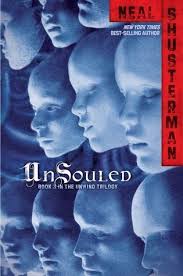
What an ending to a wild ride of a story. Is it the end of this series? I can’t say for sure. Checking Neal’s website shows me that I missed a short-story book about Lev, called Unstrung, which was sandwiched between Unwholly and Unsouled. It details exactly what went on with Lev from the time Conner kidnapped him from his tithing, until he finally ended up at the Graveyard.
Book 3 finds Conner, Risa, Lev, and Cam all together, knowing they have to pull out all the stops to finally put an end to unwinding. The key seems to lie with Sonia, whom Conner knows more about than Sonia finds comfortable. But what she does let them know, is the final work of her husband, determined to fix the mistake he made by inadvertently allowing unwinding to come to be.
A printer, that prints real human organs, making unwinding unnecessary. The powers-that-be bought this from Janson for millions, and destroyed it, making the printers, blueprints, everything disappear. There is too much money to be made in the unwinding market.
This story, and series, is definitely well worth the read. There doesn’t necessarily need to be another book to this, and it would still seem like a complete series. There is plenty of room for another story to follow. If one does, it will definitely be on my bookshelf.
I bought, and read this series, for two reasons. Because it sounded interesting, and to make sure it was okay for my 12 year old daughter to read. In my household, this is a series I will let her read (she is currently reading the first book, Unwind. There is not much in “bloody-gore” violence, but both children and adults are killed throughout the series. The actual act of unwinding is not graphic, but as I said in an earlier review, the way it was written was very disturbing to me (my imagination got the better of me). There are a lot of weapons in this story, mostly guns and assault weapons.
As a perspective, I will not let my 12 year old watch rated R movies, but she does watch PG-13 movies. I try to not let her watch any obscene, rude shows of gross humor or blatant sexual behavior. If I said I never swore in front of her I would be lying, but I do try to monitor what she is exposed to as best as I can in this internet-driven world. We have a very open relationship where we are comfortable discussing anything with each other, without the uncomfortable awkwardness that can sometimes occur.









 booksandopinions.com