More of Ben-Hur

Chapter VI, of book 4

Ben-Hur is part of a procession of people going to the Grove. He finds an opportunity to leave the group aside and trails off into the thick overgrowth of the woods. He stays for some time there, enjoying the beauty of the blooming trees and the creatures who dare show themselves to him. He quickly chides himself for having happy feelings when his mother and sister are lost.

As he works on getting away from the Grove, he notices from a bridge that what he is in is actually a wall-less temple, built strictly out of nature’s own materials.

Chapter VII has Ben-Hur going with Malluch to the stadium, where competitors will gather for the chariot races.  He learns that one of the drivers is none other than Messala, looking as haughty as ever. An instance of near death-by-chariot to a woman and her father, she on camel-back, tells us that the father is Balthasar, one of the 3 wise men we met in the beginning of the story. (Malluch was who was ordered to follow Ben-Hur; I forgot to tell you that, didn’t I?)

The opportunity presents itself for Ben-Hur to race against Messala, on the morrow, at what they call the Circus. He is quickly off to see the Sheik whom is the owner of a beautiful chariot and steed of horses, said to be descendants of the 1st Pharaoh’s horses.

As Malluch and Ben-Hur travel to the Sheik, Malluch describes the story of Balthazar, as Ben-Hur recalls the man at the fountain whose life he saved from the chariot driven by Messala was one and the same.

Further on, Malluch returns to Simonides and reports on what he learned of Ben-Hur. He states with confidence that Ben-Hur is whom he claims to be, by the things he had told him and the way he behaved. Simonides daughter Esther seems especially happy about this as well, and her father is not sure if it is because he would be their ruler or because she loves him. (I find it amazing how fast people fell in love back then, don’t you?) She confesses that she does indeed love Ben-Hur, and wishes for him to not attend Circus, and race against Messala. Simonides ponders this information as he also ponders knowing that the King to Be was indeed born, and expecting him to make his appearance in his lifetime.

The story then turns back to Messala, and a gathering of soldiers and followers amongst who he begins to hear the tale of a Roman and a Jew, whom was adopted by Quintas Arrius, yet Messala fails to make any connection to his former young friend. 

Again we go back to Ben-Hur, who has now arrived at the tent of the Sheik of whose horses and chariots he wishes to command in the race at the Circus. After discussing his plans for revenge with the Sheik, he again meets Balthazar, whom is also there with the Sheik. As they quietly eat dinner, it becomes clear that of this gathering of an Arab, a Jew, and an Egyptian, all believers in One True God, it is Balthazar that must tell his story of searching for and finding the baby Jesus.

The author kindly lets you know that from here-on-out, Jesus will be referenced to throughout the story, as this is the timeframe of when he began his ministry.

A quote from Balthazar that literally took my breath away (or I was holding my breath…)

“There is a kingdom on the earth, though it is not of it–a kingdom of wider bounds than the earth–wider than

the sea and the earth, though they were rolled together as finest gold and spread by the beating of hammers. Its

existence is a fact as our hearts are facts, and we journey through it from birth to death without seeing it; nor

shall any man see it until he hath first known his own soul; for the kingdom is not for him, but for his soul.

And in its dominion there is glory such as hath not entered imagination–original, incomparable, impossible of

increase” (Wallace, 1880, pg 166).

I have heard the kingdom referred to as already being here on earth from several different authors, including C.S. Lewis, who ended the Narnia series with everyone going up, up, higher into the garden that continued to become more bright and beautiful.

I think that is more than enough for today; I hope I am not boring you with this story, I have to say, it is one of the better books I have read! And yes, I still want to see the movie.

Wallace, L. (1880) Ben-Hur. Harper and Brothers Publishing.

Some Ben-Hur Bits

Another quick update, I am getting this read slowly-but-surely! (I have to be honest, I almost bought the movie Saturday, I have a dvd-buying problem, but I knew if I did I would watch it immediately and likely never finish the book. I will be getting the movie as soon as I get this story finished!)

Book 4

The year of our Lord 29

After 5 years, we see Ben-Hur still on a ship. The Grove of Daphne seems to beckon to him. Ben-Hur is going to the citadel, to discover who may be left of his family and servants after being told the story of his own disappearance by a Hebrew on board the ship. He was told of the supposed death of his father, and that a slave named Simonides  took over the running of the family business, no questions asked, and is now running a successful business, as a prosperous business owner.

Ben-Hur, hoping only for word on his mother and sister, is willing to free this slave for any information about these two women. Simonides has nothing to tell Ben-Hur of his family, only that they are lost. Ben-Hur leaves, disappointed in what he has been told.

Simonides, on the other hand, decides to have him followed, apparently to see if Ben-Hur is the Prince he claims to be. His daughter, Esther, is going to learn why the appearance of this stranger has made her father so extraordinarily happy. Esther learns the story of her father, and mother, and that he is indeed the slave of the late Ben-Hur, and how he came to be managing his property and business.

As Ben-Hur makes his way to what was once his home, he notices that although many things appear to be different, maybe they are really still the same (it seems to be a life-learning lesson that has never changed through the ages).  

I am anxious to read about his mother and sister, I hope he finds out something soon!

Ben-Hur in Bits and Pieces

I apologize for getting behind on updating this book. I even missed posting my Friday Fun Facts! 🙂

In the year of our Lord 24.

How the true 1st edition of Ben-Hur looks. His wife had  influence over the cover design seen here.
How the true 1st edition of Ben-Hur looks. His wife had influence over the cover design seen here.

The 1st two chapters of Book 2 basically give descriptions of the sailing vessels used during this time, and the types of workers who performed different duties, the most important seemingly being the rowers.

Arrius was the captain of this ship, and his attention had been caught by a Jewish rower, known only as rower #60.

“Ithamar, of the house of Hur.”

Chapter three has Arrius calling rower #60 to him (known to us from here-on-out as Ben-Hur) to find out his story. With hope and a happy heart Ben-Hur explains he seeks word of his mother and sister, and how the falling tile that knocked out the Roman Governor had labeled him an assassin.

Chapter 4 starts out like you would expect a children’s adventure story to begin, with pirates chasing down the fleet of Arrius. As it became obvious to Ben-Hur as he observed the actions of the crew around him and Arrius, they were indeed preparing for battle. It is a difficult thing to read that the oarsmen were all shackled to their benches, preventing any chance of escape in the event of a disaster (pg. 92). Ben-Hur was seized with anticipation, guilt, and shame as he wondered if he himself would be chained to his seat as the rest of the oarsmen were. He indeed was not; and knew then that Arrius had indeed placed him in a higher stature.

I will spare you the gruesome details of the battle that took over the sea. As Ben-Hur realized that the Romans had boarded their ship, he knew that Arrius could indeed be fighting for his life, and if he were killed, Ben-Hur would likely never get to see his mother, sister, and the Holy Land.

Both Ben-Hur and Arrius ended up in the water as the ship was overtaken and began to break apart and flood. As Arrius slowly regains consciousness and grasps what has happened, he reveals to Ben-Hur that he did indeed know his father, and loved him.

From page 100:

I shall be duumvir, and thou! I knew thy father, and loved him. He was a prince indeed. He taught me

a Jew was not a barbarian. I will take thee with me. I will make thee my son. Give thy God thanks, and call

the sailors. Haste! The pursuit must be kept. Not a robber shall escape. Hasten them!” (Wallace, 1880).

At the conclusion of book 3, both return to Quintus Arrius’ home, and Ben-Hur is made his adopted son and receiver of everything he owns upon his death.

On to book 4, with a goal of being done by week’s end! (I get a feeling I may likely regret saying that).

Wallace, L. (1880). Ben-Hur. Harper and Brothers Franklin Store.

Since I’m Reading It, I Might As Well Talk About It!

ImageBen-Hur. It looks a little intimidating. Even sounds a little intimidating. I have to say I am really enjoying this story. The descriptions Mr. Wallace uses make you feel like you are right there.

Some things from the start of the book:

Reading about the 3 Wise men from a different point of view is interesting. The Egyptian is Balthasar, The Greek is Gaspar, and the Hindoo (their spelling) is Melchior. Each individually saw the star and heard a voice tell them to seek the Christ-child that was to be born. They met at the place where the star and prophecy directed them, and each told their own story of how they came to be there.

As they began to get closer to Bethlehem, they asked those that they passed where they could find the Christ-child. The following was the general response:

pg 39 –

“Nobody knows. They are said to be Persians–wise men who talk with the stars–prophets, it may be, like

Elijah and Jeremiah.”

“What do they mean by King of the Jews?”

“The Christ, and that he is just born.”

One of the women laughed, and resumed her work, saying, ‘Well, when I see him I will believe.”

Another followed her example: “And I–well, when I see him raise the dead, I will believe.”

A third said, quietly, “He has been a long time promised. It will be enough for me to see him heal one leper.”

And the party sat talking until the night came, and, with the help of the frosty air, drove them home.

They do find him, in a manger, with many followers who joined them on their quest, bowing down to worship their new King.

Book two moves ahead 21 years, and focuses on young Judah, and his friend Messala, gone for 5 years and returning a Roman. Judah can no longer tolerate Messala, who now speaks of the Jewish beliefs as if they are a joke.

Strictly by accident, Judah knocks a Roman Governor off from his horse, and this is taken as an attempt on his life. With his whole household, including his mother and sister, Tirzah, in mortal danger, he begs for their mercy as he is taken prisoner. It is at this point that we notice the change in Judah, as he becomes a man.

Real Murders-Wrap-up!

Image

Well, I wish I could say I saw that coming, but even having read this story before, I completely forgot who the murderer(s) was/were. I would say it has been about 4-5 years since I read this story. I think out of all 8 of the books in the Aurora Teagarden series, I have read 3 of them.

Of course I will be getting the rest of them; I mean I can’t have an incomplete set of books on my bookshelf, right? This is a book that if my children had anywhere else to be other than our home, I would have gotten it read in a day.

So as to not spoil this for anyone who wants to read it; the name(s) of the guilty shall remain a secret. This really is a quick read, it is funny, and intense, and will have you holding your breath at certain parts. You may even laugh out loud. Literally. I did, and more than once. Roe has a particular way of imagining pain being inflicted on someone who is not particularly nice (yes, since this is fiction, I absolutely laughed at it; her wanting to kick someone in the nuts was rather funny, at least the way she imagined it in her head).

I have less than 3 weeks off before my next college class, so I figured what better to read than Ben-Hur. Written by Lew Wallace, at a page count of 342, this shouldn’t take me all too long….. 🙂

I may or may not review this as I go along; it is pretty interesting so far, being a couple of chapters in. I have never read this before, or saw the movie that was made starring Yul Brynner.  I may read something a little less “heavy” right along with this and keep you updated on that. As long as the stories are not in any way, shape, or form similar, I can read 2 books at once!

What great story have you recently read?

Friday Fun Facts!

Washington Irving

America's 1st International bestselling author
America’s 1st International bestselling author

Born: April 3, 1783

Died: November 28, 1859

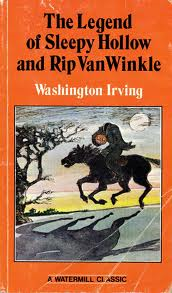
Wrote: The Legend of Sleepy Hollow, Rip Van Winkle, assorted biographies

Sleepy Hollow and Rip Van Winkle Cover

Quote: There is a legend that on the night of his death, Wahington Irving said “Well, I must arrange my pillows for another night. When will this end?”

Some Facts: Died in Tarrytown, NY, which is right next to Sleepy Hollow. As America’s first genuine internationally best-selling author.

Irving and his grave were commemorated by Henry Wadsworth Longfellow in his 1876 poem, “In The Churchyard at Tarrytown”, which concludes with:

How sweet a life was his; how sweet a death!

Living, to wing with mirth the weary hours, Or with romantic tales the heart to cheer; Dying, to leave a memory like the breath Of summers full of sunshine and of showers,

A grief and gladness in the atmosphere